Friday, August 23, 2013

Your New Money Goal: Increase Your Credit Score

We all have goals for our life. If you want to reach your goals, you need to:
  • Recognize how reaching this goal will positively impact your life, which will give you motivation for putting in the work to reach your goal
  • Identify the steps  you need to take to reach the goal
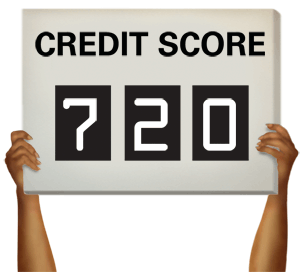
For example, if you want to lose weight, you need to determine how losing weight will positively impact your life (better health, better appearance, etc.) and identify the steps you need to take to get to your desired weight (exercise, diet, etc.)

One goal all of us should have is to increase our credit score. This number plays an important role in your life. Following are some of the benefits of having a high score:
  •  You pay less for your car insurance
  • You will be able to get your dream apartment
  • You will pay less (sometimes substantially less) for loans (including your mortgage, auto loans, personal loans and others)
  • You won’t be prevented from getting your dream job
If you have borrowed money of any kind in your name (personal loans, student loans, car loans, credit cards, etc.), you have a credit report. This report includes information about how you have repaid money you’ve borrowed. For each account it is shown if you paid on-time or if you paid late each month (30, 60 or 90+ days late). It also shows how much of each credit line you are using (ex: you have a credit card with a $500 limit and you are carrying a balance of $100).

If you have had serious money management problems, those will be clearly displayed – bankruptcy, accounts that have gone to collections, etc. Your credit report also shows how many times you have given financial institutions permission to access your credit report (also called inquiries).

Your credit score is based off information in your credit report. Your score ranges from 300-850 (the higher, the better). The following graph shows how your credit score is determined:


If you want to reach your goal of increasing your credit score, following are some steps to take:

Payment History (35%):
It’s easy – pay all your bills on time! Even if you’ve had problems with late payments in the past, if you start paying on time now, your score will gradually increase. If you need to be late, don’t hit the 30 day late mark!

Amounts Owed (30%):
This category is called your capacity – or how much of your credit limit you are using on your revolving credit lines (typically credit cards). Don’t use more than 30% of the credit that is available to you. For example, if you have 3 credit cards with a total credit limit of $1,000, don’t carry a monthly balance over $300. The lower your percentage of credit use, the better. If you do need to use more than 30%, talk to your credit card company to see if they will increase your credit limit.

Length of Credit History (15%):
This category takes into account both your oldest reporting credit line and the average age of all your accounts. Only time can improve this section. However, closing old credit cards can harm your score in this section. Unless you are paying an annual fee on a card you aren’t using, keep those old accounts open.

New Credit (10%):
The biggest part of this category is inquiries. In general, don’t apply for more credit than you need. If you have lots of credit applications, your score will drop. If you are rate-shopping for a mortgage or car loan, which is a good idea!, rate shop in a 45-day window. As long as you are applying for the same type of loan at each financial institution, all your inquires will only count as 1 inquiry.

Types of Credit Used (10%):
Lenders like to see that you can handle a variety of loans – credit cards, student loans, car payments, a mortgage, etc.

Also, remember to check your credit report regularly to make sure there are no errors that may be bringing down your score. Get 3 free credit reports each year, 1 from each of the 3 major credit reporting bureaus, at: www.annualcreditreport.com.

Know you will only get your credit report. The items in this report determine your credit score, which you have to pay a small fee to access.

Friday, August 16, 2013

About the Public Service Loan Forgiveness Program

We are always getting questions at the SMMC about the Public Service Loan Forgiveness Program. Here's what you need to know about this "money secret" few people utilize.

In order to be eligible, candidates for the program must:
  • Work full-time in a qualifying public service job for 10 years
  • Make 120 full, on-time monthly payments on their Direct Loans
After 10 years of payments, your remaining loan balance is dropped.


Ensuring that your job meets the qualifications for this program is important. For a job to be eligible, it needs to be a federal, state or local government entity or an IRS designated tax-exempt non-profit organization. A private non-profit employer may also qualify, if it provides certain public services.

These include:
  • emergency management
  • military service
  • public safety, or law enforcement services
  • public health services
  • public education or public library services
  • school library and other school-based services
  • public interest law services
  • early childhood education
  • public service for individuals with disabilities and the elderly
To maximize forgiveness under the PSLF Program, you should repay your loans on the Income-Based Repayment (IBR) Plan, Pay As You Earn Repayment Plan, or the Income-Contingent Repayment (ICR) Plan, which are three of the repayment plans that qualify for PSLF.

Other PSLF-qualifying repayment plans are the 10-Year Standard Repayment Plan or any other repayment plan where your monthly payment amount equals or exceeds what you would pay under a 10-Year Standard Repayment Plan. It’s a good idea to look into the different types of repayment plans so that the most cost-effective plan can be adopted – this may help you save money in the long run.


Because it will take at least 10 years for you to make the 120 qualifying payments necessary to receive PSLF, there is an Employment Certification for Public Service Loan Forgiveness form (Employee Certification form) that you submit to FedLoan Servicing and a process that you should follow so that they can assist you in tracking your periods of qualifying employment and your qualifying payments.
  • Step 1 — Complete, with your employer's certification, the Employment Certification form annually or whenever you change jobs.
  • Step 2 — Submit the completed form to FedLoan Servicing (PHEAA), the PSLF servicer, following the instructions on the form.
  • Step 3 — FedLoan Servicing (PHEAA) will review your Employment Certification form, ensure that it is complete, and, based on the information provided by your employer, determine whether your employment is qualifying employment for the PSLF Program.

Friday, August 9, 2013

Free Things to Do in Lincoln in August

During this time of year, there are plenty of free activities that UNL students can take advantage of. Lincoln offers free attractions, activities and events for Huskers – everything from concerts to sporting events and everything in between. All information has been taken from the corresponding websites.

  1.  Pioneers Park is a great place for people to explore the natural environment of Nebraska. The environmental education center and wildlife sanctuary has over 650 acres of tallgrass prairie, woodlands, wetlands and a stream. The park is open 362 days a year. Admission is free, but donations are suggested.
  2. Holmes Lake is a 112 acre lake located on Antelope Creek. Fishing, hiking, biking, picnicking and golfing are popular activities at this location. The Hyde Memorial Observatory can also be found here. It is open to the public every Saturday night until 11 pm through September and 10 pm through March. You can view the night sky through three of the observatory’s telescopes.
  3. Party in the Parks is a new community art and entertainment series that features live music, visual arts, food vendors and kids' activities. The upcoming date is September 28th, from 4:00 pm to 9:00 pm.
  4. The Haymarket Farmer’s Market runs every Saturday from 8:00 am to 12 pm until October 12th. Live entertainment can be found on stage in Iron Horse Park with street musicians on every corner. The market itself has a wide variety of fruit, vegetables, meat, baked goods, plants, arts, crafts and much more.
  5. The Fallbrook Farmer’s Market is a great place for live music, family friendly events, and handcrafted and artisanal products. Fresh, seasonal produce, farm-raised meats and eggs, farmstead cheeses, breads, pastries and much more are sold at every market. Its hours of operations are every Thursday from 4:30 pm to 8pm.
  6. Students and Rec Center members are offered one free climb at the UNL Climbing Wall per semester. All essential equipment, including seat harness, belay device and climbing rope is provided by the Rec. A staff member will be ready and available to assist anyone at the wall.
  7. Some Husker athletic events are free for students, including baseball, women’s basketball, soccer, gymnastics, track and field and more. Students have to present their N Card at the gate and admission is free.
  8. UNL’s Botanical Gardens are a wonderful place to take a stroll and admire the many different types of flora. The gardens can be found in multiple places on both City Campus and East Campus. On City Campus, they are located by the Cather, Love, Andrews, Burnett, Donaldson and Sheldon buildings. East campus houses The Earl G. Maxwell Arboretum.
  9. The Sheldon Art Museum houses the Sheldon Art Association collection founded in 1888 and the University of Nebraska collection, initiated in 1929. Together they comprise more than 12,000 works of art in all media. The Sculpture Garden has more than 30 monumental sculptures which are exhibited all year. The Sheldon's exhibition program comprises approximately 20 exhibitions per year and focuses on American art in all media. Admission is free. The museum hours are as follows: Tuesdays from 10 am to 8 pm, Wednesday through Saturday 10 am to 5 pm, Sunday 12 pm – 5 pm.
  10. Morrill Hall features exhibits on natural history, prehistoric reconstructions of mammals, reptiles and dinosaurs as well as the world-famous Elephant Hall, where visitors see the world's largest articulated fossil mammoth among the premier collection of fossil elephants. Admission is free for UNL students, faculty and staff. The hours Monday through Saturday are 9:30 am-4:30 pm, Thursdays are 9:30 am-8:00 pm and Sundays are 1:30 pm-4:30 pm.
  11. The Mueller Planetarium is a part of Morrill Hall, but offers its own unique exhibits and shows. For almost fifty years, the planetarium has educated audiences with exciting fulldome multi-media presentations exploring the latest discoveries in astronomy. The operating hours are the same as Morrill Hall.

  12. Sunken Gardens features an annual floral display that consists of over 30,000 individual annual plants which are redesigned to a different theme each year. It is the only Nebraska garden listed in the “300 Best Gardens to Visit in the United States and Canada” by National Geographic Guide to Public Gardens.
  13. It’s important for any Husker fan to visit Memorial Stadium. The self-guided tour takes fans into the Stadium, with limited field access, at Gate 24 (when no teams are practicing) and around the stadium. Tours can be taken seven days a week from 8 am to 8 pm.
  14. International Quilt Museum offers visitors a one-of-a-kind look at historical and contemporary quilts and quiltmaking traditions. The museum’s hours are Tuesday to Saturday from 10 am to 4 pm and Sunday 1 pm to 4 pm. Admission is free for UNL students, faculty and staff.
  15. The Pinnacle Bank Arena is having a Husker Watch Party during the Nebraska vs. Wyoming football game. You can watch the Huskers take their opponents on the arena’s Panasonic high definition center scoreboard with video on all sides in the main arena. Admission is free and there will be food and favorite beverages for sale.

Friday, August 2, 2013

Best Back-to-School Savings

Following are our top 5 finds from the multitude of back-to-school sales going on right now!


Target Bedding Collections

We especially love the $19.99 sunglasses comforter!


Target Stick Lamps

These quirky lamps are all under $18!


Walmart Big Joe Roma Chairs

Perfect for hanging out or studying! A very affordable furniture buy at $39.


Bed Bath & Beyond Owl Scarf & Belt Organizer

Keep all your favorite accessories in one place with this $9.99 adorable organizer!


Walmart 8x10 Mounted Photos

For $12.96, create cheap artwork out of your favorite memories!

Friday, July 26, 2013

Getting the Best Deals on Textbooks

Our SMMC reps are often asked where to get the best deals on textbooks. The #1 place we recommend is the University Bookstore. They offer great prices, the ability to rent books, AND great customer service.

As for textbook websites, we've had good experiences with the following:


Amazon.com

Amazon.com is a staple for many students. Amazon offers both used and new editions for many textbooks Huskers need. Also, if you have a Kindle, they offer electronic textbooks.

One of our SMMC reps recently had to purchase a book for her financial planning class. A pricey book! On Amazon, a new copy was $123 and a used copy was $118. Being a Kindle fan, she chose to go with the Kindle version, which was $82. She saved $36! She was able to get free shipping.

Being this was her first Kindle textbook purchase, she was worried she wouldn't be able to easily search for all the tidbits of knowledge she needs, but found that her Kindle's search capabilities made it incredibly easy to find what she was looking for!


Valorebooks.com

Another of our SMMC reps is loving Valorebooks.com. They offer new, used, rental, and sell-back options.

We used this website to search for the same financial planning book that was purchased through Amazon. The price for a new version was $139, used was $130, and renting was $73.

Obviously it's a great deal to rent. Shipping is free. The rental period is 125 days.

Is it better to rent rather than buy and sell back? Sometimes. In this example, if we would have purchased the book for $130, the sell-back amount would have been $70. We would have spent $60 and saved $13. However, lots of students like to keep their books so they can reference the material in the future.

Also, there is never a guarantee that you will be able to sell your book back. A new edition may be released that eliminates the market for your old edition.

Valorebooks.com also offers additional savings promotions throughout the year, including buy 3 textbooks, get the 4th for free!


Chegg.com

This is another favorite for UNL students. However, we didn't have much luck finding a good price on our financial planning textbook. We could either buy it for $159 or rent it for $135. The rental period ends on December 21st.

However, some students do find good deals on Chegg.com. This example shows that you do have to put in a little effort and shop around to find the best prices.

Friday, July 19, 2013

Secrets for Financial Success Especially for UNL Students

During our last 3 years at UNL, we have identified basic financial principles our students do not know. Ignorance of these principles hinder students from reaching their life goals, and living the lives they dream of and deserve.

Therefore, we are starting a list of the basic financial principles our students need to understand. We will add more items to this list as we continue to engage with students and understand the financial knowledge they lack.

These principles will be used in workshops throughout the fall semester.

You have to put in some effort in order to build a good relationship with money.

Your money will help you achieve what you really want out of life, like getting your dream job, house, or starting a family. The first step in building a good relationship with your money is figuring out what you want and determining how your money will help you achieve that goal. For example, if you want to go on a study abroad trip, you must determine how much you’ll need to achieve that goal and create a plan for how you will get enough money to achieve that goal.

The second step in creating a good relationship with money is to guide your money to help you attain your needs, your wants, and your financial goals, by creating a spending plan. A spending plan is your financial map and helps you keep on course to living the life you dream of and deserve.

Even while in college, you constantly need to be proactive about your financial future, in order to be on the path to a successful financial future.

All your money behaviors affect how your how your life will shape out in the future. Before you make a money decision, you must ask yourself if that decision will help or hinder you from living the life you dream of and deserve.

One such situation students constantly find themselves in is deciding if they should have a credit card. Before you use credit, think about your financial future. If you get a credit card and practice these good credit habits: use it at least once a month, pay your bills on time, pay the full amount so you aren’t charged interest, and don’t charge more than 30% of your credit limit - you will build a good credit score, which banks & credit unions will use to determine if they will loan you money for a house or car, and how much you’ll pay in interest. Your future employer will also check your credit score to see if you are responsible.

However, if you get a credit card and don’t make the payments on time, don’t pay off your balance in full each month, and max out your credit card, you will look forward to paying more for any money you borrow through higher interest rates, and could be denied your dream job.

Remember, the decisions you make in college will ALWAYS affect your future! In order to have a nice standard of living when you graduate, you must keep debt as low as possible.


It’s imperative for your future financial success to graduate with as little debt as possible.

If you decide to take out more in student loans than you need, that mistake will haunt you. You will waste money on interest payments, which is particularly harmful when you’re young because of compound interest, which leads into the next principle.


In order to be able to support yourself, and enjoy yourself, when you retire, you must start investing as soon as you can.

How do people build wealth? Through investing and earning compound interest, which means you earn interest not only on what you put in the investment, but also on any interest that is earned. The younger you start investing, the more money you’ll have in retirement. If you can, start investing in college through opening a Roth Individual Retirement Account, a tax-advantaged retirement account for young people. When you get your first job, start investing in your company’s retirement account – their 401K - right away. Your company will also contribute money to your account, which is FREE MONEY, but you do have to put in some of your own money in order to get the free money.

Are you scared of investing? There’s nothing to it! Most retirement accounts are made up of mutual funds, which are collections of investments like stocks and bonds, which are managed by a professional. You put your money in and the professional makes sure you make money. You will need to choose your mutual funds by your risk tolerance. If you want no risk of losing your money, you will go with a conservative mutual fund. If you will allow some risk, meaning there’s a larger chance you might lose some money, but there is also a chance you’ll make lots of money, go with an aggressive mutual fund.


You must be proactive about saving money.

Most students have good intentions when it comes to saving money. However, students engage in three behaviors they think are saving them money, but are actually making them waste money.

Many students impulse spend, meaning they forget about their spending plan and purchase things that give them a temporary retail high. You need to constantly think about your future and your goals. Even that $2 impulse buy is slowing you from reaching your goals. Before you buy something you don’t need, STOP and wait at least 3 days. If you still want it after 3 days, make sure that purchase fits into your spending plan.

Another behavior tied with impulse spending is not being a good consumer and doing your research. The best way to save money, especially on big purchases, is to get into the habit of doing your research. You need to search the web to determine if you are getting the most quality product for the best price.

Many students think that if they have a coupon, that means they are getting a great deal and need to purchase the product. However, is it really a deal if you’re buying something you don’t really need?


You must protect your money.

It’s a devastating scenario when someone builds up wealth by practicing good money habits and then loses this wealth due to not having adequate protection. Insurance is the first thing that students think of concerning protection. While in college, you need to make sure you have adequate auto and health insurance, as well as renter’s insurance if you live in an apartment. This will protect your belongings in case of fire or theft. After college, you will still need auto, health, and renter’s insurance (or homeowner’s insurance if you buy a house.) You will also need to consider life insurance, which protects your loved ones in case of your death.

Another form of protection is having an emergency fund for unexpected expenses. If something comes up, like a car repair, you DO NOT want to have to resort to credit to pay the bill. You will waste money on interest.

Why is the UNL Student Money Management Center here?

To help you be proactive about your life-long financial success, to help you avoid money mistakes, and to help you gain confidence in yourself and your ability to manage your financial life. We can do it! We can all be financially successful!

Friday, July 5, 2013

Help Us Prevent Student Loan Interest Rates from Doubling!

ASUN and the Student Money Management Center have been working diligently with the Association of Big Ten Students in accordance with National Campus Leaders to battle the threat of doubling student interest rates.

Yesterday marked the deadline for a hike in student loan interest rates, an increase affecting 7 million students. Congress left town Friday without taking action to prevent the interest rates on new subsidized Stafford student loans from doubling 3.4 percent to 6.8 percent on July 1. Subsidized Stafford loans are low-interest rate loans available to students with financial need.

To put the magnitude of this issue into perspective, consider that the typical UNL student has around $21,000 in student loan debt.

If all those loans are subsidized and the student takes the standard 10-year repayment plan, the interest they will pay over the life of the loan jumps from $3,400 at 3.4% to $8,000 at 6.8%.


When faced with this issue last summer, Congress postponed the increases for one year. Lawmakers went home this time without an agreement on a long-term solution, though the Senate on July 10 will vote on a proposal that would extend the 3.4 percent interest rate for another year.

White House spokesman Matt Lehrich said the Senate "will take action in the next few weeks to fix this problem. We are confident they will get there, and that the solution will include retroactive protection for students who borrow after July 1 so that their student loan rates don't double."

Source: pbs.org

  Take Action!

Help us ensure that Congress does find a solution that protects student borrowers by making your voice heard!

Contact our State Representatives and let them know how truly important it is for students to have access to an affordable education.

Contact Nebraska State Senator Deb Fisher
Contact Nebraska State Senator Mike Johanns
Contact Nebraska Congressman Jeff Fortenberry
Contact Nebraska Congressman Lee Terry
Contact Nebraska Congressman Adrian Smith
Other Senate Contacts
Other Representative Contacts

Example Email

You can copy and paste the following text in order to quickly and easily communicate with our government officials.

Dear [NAME]:

My name is [NAME]. I am a [CLASS STANDING] at the University of Nebraska - Lincoln studying [MAJOR].

I, on behalf of the students of the University of Nebraska - Lincoln, urge you to take action to prevent an interest rate increase on subsidized Stafford loans from 3.4% to 6.8%. If Congress doesn’t act soon the doubling of these rates will make it harder for millions of students to have access to an affordable, quality college education.

If Congress allows the Stafford interest rates to double it will put an increased economic burden on University of Nebraska - Lincoln students. If UNL is made less affordable due to Congress’ negligence the students that will suffer the most are lower to middle class students. Making college less affordable will have a lasting negative impact on our nation's people.

Due to the damage that the doubling of the Stafford interest rates will do to our campus community, we demand Congress act now to protect students and vote not to double the interest rates. If Congress is as interested in investing in the future of America as both sides claim, then invest in us, the students, by voting against the impending doubling of Stafford interest rates.

Thank you for your service and for fighting for the best interests of Nebraskans.

Sincerely,

[NAME]

CLICK HERE TO LEARN ABOUT THE SOLUTIONS CONGRESS IS CONTEMPLATING